NDRE
Normalized difference red edge index (NDRE for short) is a method of measuring the amount of chlorophyll in the plants. The best timing to apply NDRE is mid-to-late growing season when the plants are mature and ready to be harvested. At this point, other indices would be less effective to use.
Let’s dive into details and see how to use normalized difference red edge vegetation index for monitoring crops on our Platform. You will find out why this index is more effective at later stages of plant development.
Why NDRE is Your Most Powerful Tool for Mid-to-Late Season
This is NDRE's superpower. Get a precise map showing exactly which areas of your field need a nitrogen boost to finish strong, saving you from wasting money on areas that are already well-fed.
Because NDRE measures the health of the entire plant structure, it gives you a much more reliable forecast of your final yield, especially for dense crops like corn, wheat, and sorghum.
Discover hidden issues of nutrient tie-up, compaction, or disease that are completely invisible from the road and even to NDVI.
NDRE is the ideal technology for perennial crops with consistently thick canopies, helping you monitor tree and vine health throughout the entire season.
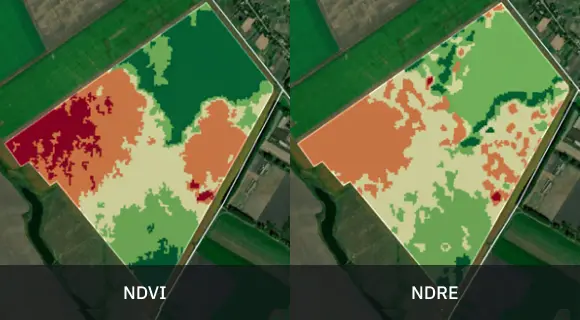
NDRE Vegetation Index: How It Monitors The Health Of Crops
NDRE is a vegetation index used in remote sensing for measuring the chlorophyll content in plants (read more about precision agriculture). It is represented by a certain value calculated using a combination of a Near-InfraRed (NIR) band and the RedEdge range between visible Red and NIR. The NDRE formula is:
NDRE = (NIR – RedEdge)/(NIR + RedEdge)
Such a band combination makes NDRE extremely sensitive to those wavelengths of light that are reflected by the chlorophyll contained within the plants.
The normalized difference red edge index can, therefore, be applied to confirm whether a growing plant is healthy or not. Low amounts of chlorophyll may indicate the problem crops:
- sick plants,
- plants infested with pests,
- plants with nutrient deficiencies,
- damaged plants.